


Young Workers Conference 2026: a better workplace and a better world
October 28 2026Young union members demanded action over apprenticeships, AI, work intensification and a wide array of other questions at last week’s National Young Workers Committee (NYWC) annual conference.
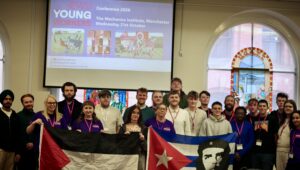 Scores of delegates attended the Mechanics Institute, Manchester last Wednesday (21st October) to discuss issues facing young union members in the workplace, wider society and the world at large.
After an opening event and pub quiz the previous evening, Wednesday morning saw proceedings be opened by committee chair Jake Lawlor, who introduced North West and North East regional official Carl Webb as conference’s inaugural guest.
Facing Bigotry at Work
Following the introductory speakers, delegates plunged into serious discussion on industrial issues, with Glasgow and Motherwell delegate Louis O’Connor moving an opening motion urging BT Group to develop education programmes and mandatory training sessions over hate speech.
Deploring how so many workers “pick on other groups of people like single parents, migrants – anyone” out of the fact that they “can’t see the problems caused by billionaires”, Louis said that “companies such as BT and Royal Mail have a duty to try and steer people away from such speech.”
Backing Louis was national committee delegate Hollie Gregg, who pointed to the previous summer’s pogroms against migrants in Belfast and Coleraine as “the reality of this language being played out”.
In her words, it was “a clear step forward for young workers to push fellow workers and their managers to “to oppose hate speech being spoken brazenly in public.”

Training First, Not Firing First
Delegates widely discussed the necessity of defending existing apprenticeships on a cross-employer basis, voting to mandate the committee to work with the union’s leadership to campaign for protecting and expanding entry level work among employers and the government.
Speaking on the question, Somerset, Devon and Cornwall delegate Rosie Davison asked: “what happens to a young apprentice who does everything right, but still gets told there isn’t a job at the end of their apprenticeship?”
“Apprenticeships are an investment in the business, the company and the industry.
“An apprenticeship that leads nowhere can’t be called a pathway, or a genuine chance to build a career, and young workers can’t be treated as the easiest to cut when times get hard.”
Louis O’Connor said that unions “should be putting pressure on employers to invest in people, this country, and future generations”, while Edinburgh, Dundee and Borders delegate Aisha said that “I know what it means to make a thousand applications and get nothing back, where the levels of experience expected in ‘real work’ from people who have just graduated is just impossible – you’re left on an uneven playing field”.
Delegates also called for a ‘comprehensive cross-sector audit’ of companies using digital tracking, security logs and data to track disciplinary incidents, and to demand a ‘training first, not firing first’ approach to new workplace technology.
Describing how errors at work are becoming flagged by technology at work, NI Telecoms delegate Issac Cave said that “we’re not machines, and being instructed and monitored by machines is deeply degrading”, while Midlands delegate Tom Fallon described the “eye in the sky” surveillance at Royal Mail, where Postal Digital Assistants (PDA) allow “blatantly distrustful” managers to “watch every step and count every minute of our breaks.”

International Solidarity
Delegates also moved two emergency motions: one supporting the French students and educational workers protests, and another which declared solidarity with the people of Cuba against US intervention.
Denouncing Donald Trump’s “continued escalation” against Cuba, delegate James Mason described the maneouvring of Washington D.C. as “an act of economic punishment which may lead to a bleak and dark future for Cuba.”
NI Telecoms delegate Issac Cave added that Cuba is “everything the US isn’t – it’s a well-educated, well-informed, stable country which is, for the most part, efficient in everything it does.
“Cuba’s main export is doctors – something the US couldn’t even comprehend.”
Climate Change, Maximum Heat and AI
Delegates also discussed the growth of data centres and the role of AI. Discussing a motion mandating the committee to ‘push back aggressively against unchecked AI rollouts’ and ‘the right of workers to reject detrimental AI implementations’, UTAW delegate Dan Hoult said that allowing data centres to take unlimited water utilities and power “is a disgrace to the country.
“It’s just wrong, it’s not a good use of time or money.
“We need to challenge employers steamrolling AI into the workplace without the consultation of workers – it should be working for us, not us for it.
“Ultimately, our members are going to be bearing the brunt of these implementations, and we need to make it fit for them.”
A later motion also deplored the use of AI in trade union work, and instructed committee to work with the NEC to develop educational material which “addressed the full ramifications” of AI being used for union work.
In motions which discussed implementing a maximum heat working temperature for strenuous and non-strenuous work, delegates described the intensity of their work in an age of climate crisis.
Western Counties branch delegate Caio Whitmore called for a maximum working temperature “that more appropriately reflects this century”, while Midlands delegate Lauren Taylor movingly described her work climbing telephone poles.
“At work, up there, I’m in a hi-vis, in a hard hat, in gloves.
“It’s warm in winter, which is great – but when summer hits, and it’s over 30 degrees celsius, I really struggle.”
Describing how such heat intensely stresses workers and impacts people on a wide variety of prescribed medicine, she called for a “challenge” over temperature limits, telling delegates: “we’re expected to get just as much done in extreme heat, and it’s not possible or acceptable.”

Doing the Round, Not the Iron Man
After discussing motions over reviewing EE’s annual leave booking system and deeper training for younger union reps at Royal Mail, delegates instructed the committee to campaign inside Royal Mail for communal letter boxes inside of flat blocks.
Moving the motion, Northern Home Counties Postal branch delegate Amira described how, having climbed 27 flat blocks without a single lift, “I realised postal workers were athletes.
“It’s not just that it was physically exerting enough, but I had to take additional blocks because I was with a colleague with knee problems.”
Hammering home the point of the motion, Amira said: “Let’s be realistic, repeatedly climbing flights of stairs with parcels getting bigger and bigger is inevitably going to take a physical toll.
“If we don’t speak up now, we’ll be pushed until we’ll be the ones needing reasonably physical adjustments after the damage is done.
“We’re trained to deliver the post, not do the Iron Man Challenge.”
Maintaining the Work and Freedom Divide
Delegates also moved a motion to further enshrine the ‘right to switch off’, with Hollie Gregg warning delegates of “blurred lines” between work and free time being created by working from home.
“The companies we work for are so focused on profits that they’ll squeeze every last drop out of you.
“Home working can have these huge implications, and it’s imperative that we protect our existing rights and build on them.”

Renationalising Royal Mail
In one of the boldest speeches of the day, national committee delegate Asa Cook moved a motion which called for the renationalisation of Royal Mail under democratic workers’ control.
Carrying the motion, Asa described privatisation as “a wound that wouldn’t heal”, and described the need to remould Royal Mail as a publicly-owned workers’ monopoly in the postal sector.
Seconding the motion, North Midlands delegate Amira asked: “Who is Royal Mail actually working for?
“Workers are being asked to do more for less while customers are disappointed and increasingly questioning the service.
“Royal Mail doesn’t deliver a single letter without a worker, so why are the people who do the job the last to be heard from?
“If they can measure the steps a postie takes a day, then we can work out a way to measure their damaging targets.”
Tidying the Union, Unions in Society
Before finishing the day’s proceedings, delegates voted to deploy a modern document system that would hope to reform the union’s current information infrastructure, and a final motion called for schools to teach the history and purpose of trade unions.