



Workers will resist “car crash” working arrangements and fight for new entrants
Postal, Royal Mail Group (EMP) March 11 2026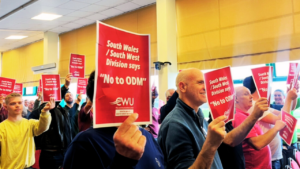
Postal workers will continue to fight the “car crash” that is the Optimised Delivery Model (ODM) and fight for equalisation of new entrants, the union’s leadership has said.
Hundreds of South Wales and South West region members attended a meeting on Monday 23rd February in Taunton, where they first heard from Deputy General Secretary Martin Walsh, who outlined the current situation.
Warning that the USO faces its “most dramatic change since 1968”, Martin opened by paying tribute to union representatives “getting flak for a workplace crisis that isn’t their fault”, in a climate where Royal Mail’s financial position is only adding to pressure. The union, he said, “is urgently trying to resolve it”.
Last July, the union secured a reasonable 4.2% no strings pay deal. There were commitments to reach a USO agreement with the aim by July and both EP and Royal Mail recommitted to the equalisation of new entrants pay, terms and conditions.
Questions over the Optimised Delivery Model (ODM) were addressed, with Martin echoing the majority of workers who felt ODM was “a car crash”, and that the union could not support it as it stands.
This was ratified by the release of a poll which showed that every pilot office balloted on ODM has rejected the model in favour of the union’s position.
Additionally, “unconstructive” meetings have led to tensions where EP Group have alleged that without ODM, “the future of the company is in fundamental jeopardy”., and that in a meeting with both EP Group and the union, a minister of state said he supported finding an agreement and requested a commitment that there would be no industrial action or executive action before 16th March.
When considering the “huge pressure” from Ofcom that Royal Mail are under, Martin also said the company are “moving seriously” on ODM, but that it was not enough to reach an agreement, nor enough on the table over equalisation, and that talks will continue until 16th March.
Members also heard thorough and detailed debriefings by national officers Andy Furey, Davie Robertson and Tony Bouch, as well a rousing speech from divisional rep Ralph Ferrett, who said that “multiple units in our division” have already voted for a rule 13 on industrial action, with more “coming in thick and fast”.
“Don’t pretend otherwise”, Ralph told members, “people aren’t happy with us – but there are serious stakes at play.
“The greatest trick the company pulled is convincing us we were done and dusted, but look at the difference we make every single day – that is power.”
Views From the Ground
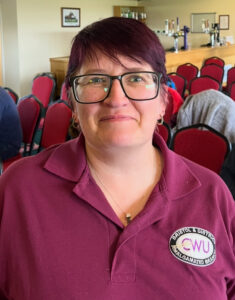 For Emma, a Learning and Training Officer at Thornbury DO, workers need wins on the ground quickly. In her office, considerable numbers of new entrants have joined, but many new entrants, she says, have an ‘it is what it is’ approach to the poor pay and conditions.
“Almost all the time, when I ask them to join, they say they can’t afford to”, she says. “They get paid so little they don’t have a tenner a month to join the organisation fighting for their conditions. We need something concrete from this situation to show them that things can go in our favour.”
This also means clear progress on equalisation. “We need to get beyond the rhetoric – us reps know it’s Royal Mail not coming to the table and enacting change, but to people in our offices, too many people think it’s the union not delivering on agreements.”
James from Exeter DO, who started work just before the 2022 strike, concurs that things are “a bit of a mess”, but believes most new entrants are joining the union at his workplace.
He says that the general environment is currently “difficult to manage”, with plenty of pairings and lots of job shares, and that it’s hard to guess exactly what customers would expect from the USO, with him meeting residents wanting “something every day” and some “who are quite happy not getting their bills on time”.
Area safety rep for Gwent Rob Pitt also thought of the “difficulty” in equalisation and ODM.
 He describes the implementation of the deal as a “constant question” when recruiting new entrants, and that members need to emphasise to non-members that “the more we sign up, the stronger we are, and the easier it is for our people to go and negotiate.”
Rob had three ODM pilot offices in his area, and in terms of shift patterns and different duties, “we saw first-hand how difficult it was”. All the workers who have been on that model “have lived and breathed it, and know it’s not fit for purpose.”
Emma added that Royal Mail would be “foolish” to “abandon the connection we have in our communities” for casualisation. “Look at the constant complaints Evri and Amazon receive. It’d be terrible if we took this route of giving up standards – it shouldn’t be about delivering order number whatever, it’s about delivering to Mrs Smith at number five – that’s our customer.”