



“Putting a face to the miners”: a CWU member unravels forgotten history
Union Matters March 13 2026
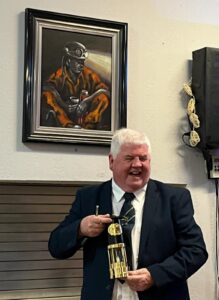
Hughie with miners lamp
CWU Glasgow & District Amal Branch Officer Hugh Gaffney’s debut book about one of the biggest mining disasters in British history is a powerful tribute to those who ‘paid the price of coal’ – and the communities that stayed strong.
In late January, over 100 people filled up the Auchengeich Miners Welfare in Moodiesburn, a village 10 miles north of Glasgow.
Under paintings of the colliery and framed photographs of locals, the crowd was there to celebrate the release of Auchengeich: Gone but Not Forgotten, the new book by Hugh Gaffney.
The book, which is Hugh’s debut, is the first ever comprehensive look at the disaster at Auchengeich colliery on September 18th 1959, which was caused by a fire which asphyxiated miners just starting their shift.
With 47 miners dead, 41 women widowed and 76 children being left fatherless, it was one of the worst disasters in British mining history, with 50-year-old Tam Green being the sole survivor.
Some attendees had travelled hundreds of miles to attend, but the vast majority were locals, listening to songs from local entertainers and speeches from former miner and councillor Willie Doolan, Labour MSP Richard Leonard and Hugh himself.
Gaffney, who has been active in the CWU for decades and served as the Labour MP for Coatbridge, Cryston and Bellshill from 2017-19, was praised by Willie for writing an “immense tribute” to those who died on that fateful day, and the community that lived on.
To laughter and applause, Willie told the audience how Hugh – “the wee man” – had “promised this book was going to happen, and he really has delivered.” Richard added that “this book is a history of the workers as well as it is a history of the nation – unpolished, raw, but vast in scope, and a tremendous testimony to these communities.”
The Cost of Coal

Hugh Gaffney with former Auchengeich miners and their relatives.
Although Hugh has released the first book on Auchengeich, it was not so long ago that the tragedy was unknown to him. Despite having spent his entire life living nearby, he only heard about the place 20 years ago while serving as the secretary of North Lanarkshire Trades Union Council.
At a meeting, a guest speaker discussed the tragic events that took place. No delegates in the room had heard it. “I asked, I’m awfully sorry, but where’s Auchengeich – is it up in the Highlands?”
To Hugh’s shock, the reply was that Auchengeich was a mere six miles away from where the meeting was held. This shock spurred him on; soon, he began attending memorial services for the disaster, which happen every September and attract visitors from as far as Durham and Wales.
“Every year”, he says, “they would read the names out. But it’d only be names – never pictures, never who they were or what they meant to the people who loved them. I wanted to go about changing this – I thought, this can’t be right.”
When he asked around if there was a book on the disaster, the response tended to be: “no, and when are you writing it?”
Building up the Book
During the 2022-23 Royal Mail strikes, Hugh found himself suspended from work, in what was an obvious case of obvious victimisation over his loyalty to the union.
With this unexpected free time, Hugh began writing with the loving encouragement of his wife Anne, who tragically died before the book’s completion.
The book is the product of this unfailing warmth from Anne and others in the local area who believed thoroughly in what he was doing. “There was a great community spirit when I needed it”, he said. “Families really took their time with me”.
Meeting with Hugh, many children and relatives of the victims found it cathartic to discuss the vivid memories they had of their lost loved ones before and during the disaster, as well as their long bottled-up memories of the day of the tragedy.
One of the people who particularly aided Hugh was Eddie Savage, a local teddy boy who was engaged in mines rescue work and was one of several men praised as heroes for attempting to save the men – and rescuing Tam Green, the one surviving miner.
Early in the day and late at night, Eddie would video-call Hugh from his home in Australia, discussing the events.
Though he died before the book was released, Hugh made sure he got a draft copy; having known Hugh had completed the book, he told him towards the end of his life that “I can rest now”.
Grateful also is Beth Bradley, whose father Tommy McMonagle worked at Auchengeich. Having usually travelled down the pit with three of the same workmates who lost their lives, Tommy had stopped that day to help a miner having trouble getting his boots on – an act that undoubtedly saved his life.
On the day of the disaster, which happened at 7am, Tommy didn’t return home until after 7pm, as he had stayed to assist the rescue team in whatever they needed. When he came home, she remembered, “it was the first and only time I saw my dad cry.
“I was with my mum and my nana. We were standing, and he came in the backdoor. They must have known the day he’d had – she was standing with a towel, and he came through and just let go.” Tommy returned to the pit every day to help bring his dead workmates out, and attended all of the funerals.
Unbreakable Communities

Hugh with Beth Bradley, daughter of Auchengeich hero Tommy McMonagle.
What comes across clearly in Hugh’s book is the togetherness of mining communities both before and after the disaster.
Hugh writes warmly about Auchengeich Miners’ Club, which for over a hundred years has provided a rich environment for workers to relax, learn and organise – particularly during major mining disputes and strikes, where the venue has served as a base in the struggle.
Also described is the solidarity shown in the Scottish coalfield and the wider country after the disaster.
In just weeks, £180,000 was raised by communities, councils and working-class institutions for the widows’ fund – equivalent to approximately £3 million today. Huge concerts were held, and there was even charity football friendlies between all major Scottish football clubs.
Today, some of this local spirit can be seen in the word-of-mouth campaign to publicise the book. From libraries to miners’ welfare clubs, Hugh is getting dozens of invitations to hold meetings and presentations about his research. Hundreds of copies have been sold in a few months and has received countless encouraging remarks.
“There’s been nothing but positivity. I’m getting people turning up to these events, telling me things like – you’ve done my father proud.
“One woman bought the book, then asked me if I could send her another, since she hasn’t been able to get it out of her husband’s hands since she brought it back to the house!”
To Hugh, all of this is worth it to finally commit to posterity what the tragedy that engulfed a mining community on September 18th 1959, particularly as those who remember the event only grow older.
“We’ve got to remember there are three or four generations now that’ve never seen coal – never known what the miners done underground, or the communities they forged.
“For now and the future, I wanted them to have a book. People can now put a face to the miner.”
Hugh’s effort can be best summed up by Beth, who reflects about Auchengeich: Gone but Not Forgotten, that her father, who lived until he was 83, had been told that those who had gone to help would soon get proper recognition for what they did.
They never did, and with the exception of a beautiful monument outside the Miners Club that is lovingly tended to by the community, nor did those men who died, until this book. “Thank God they’re all put in one place now,” Beth says. “All those memories, all that history, it’s all in Hugh’s book.”
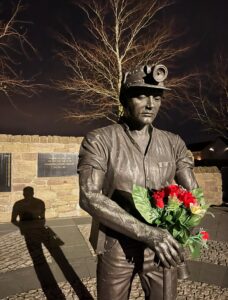
Auchengeich Miners Memorial, Moodiesburn, Scotland.