



Day 5 at the CWU Conference – Postal
Postal, Union Matters April 28 2022
Conference opens with moving and respectful Memorial Day tribute
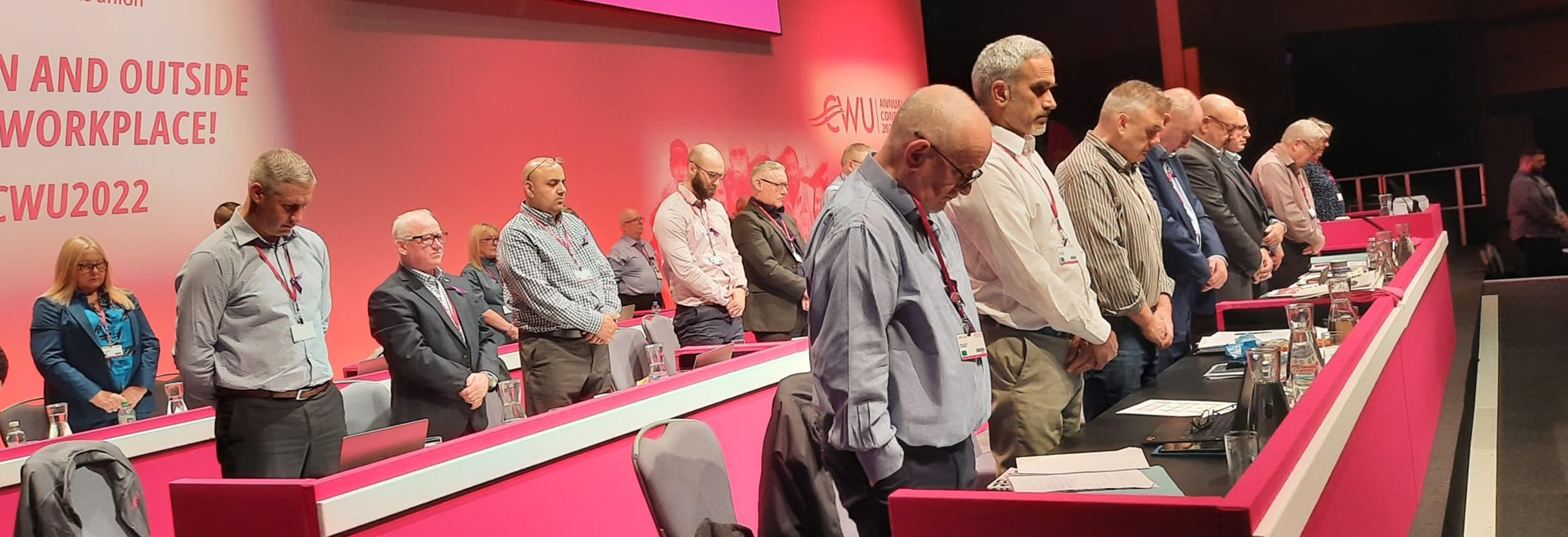
Workers Memorial Day was commemorated at Annual Conference this morning, with delegates standing for a minute’s silence before they started the business of the day, Terry Pullinger leading the tribute in Postal Conference, saying: “This year in particular we remember those we lost to the pandemic and, as we respect them, we recall the theme of Workers Memorial Day, which is the remember the dead and fight for the living.”
Protecting our members – defending face-to-face appeals
Delegates unanimously backed an emergency motion demanding a return to face-to-face appeals, telling Royal Mail that its attempt to make this emergency Covid measure a permanent arrangement constitutes executive action and is potentially discriminatory to employees.
Moving the motion, assistant secretary Carl Maden explained that the union had accepted the need to move these meetings online at the height of the public health crisis in order to minimise unnecessary contact in accordance with Government regulations and NHS advice. But, despite restrictions having now been lifted in all four parts of the UK, the company has said that it intends to continue to carry these out virtually, except for in some specific locations across the country.
As well as threatening both the spirit and intent of longstanding agreements between the CWU and Royal Mail, forcing members to choose between travelling potentially long distances or submitting to an online process was deeply unfair and Carl said that, if the motion was passed, the union would stand solidly behind these members.
“If any of our members want a face-to-face appeal and can’t have it in their locality, we’ll defend every single member and, if the branch wants to ballot, we’ll back it in the executive and we’ll take the business on,” he pledged.
Seconding the motion on behalf of the Postal Executive, DGSP Terry Pullinger said that the company’s attitude here was “a cynical attempt” to cut costs on the basis of what were emergency and exceptional measures and that, in his opinion, this type of unilateral action by employers had been increasing recently, commenting: “I think a lot of businesses seem to have been inspired by P&O.”
More rep training needed in Royal Mail & Parcelforce
With revisions having taken place right across delivery – and their equivalents at other Royal Mail functions – over the past year, it was no surprise that rep training was discussed in detail today, with Ian Corrin of Greater Mersey Amal Branch moving the first of these propositions – his motion citing the need for training on the resource calculator, weighted items per work hour (WIPWH), the indoor workload tool, delivery duty set, resource control system and weekly resource meeting. And he was supported by South West Wales Amal delegate Mark Williams, who told the hall that this was “one of the most common training requests I’m getting in my area.”
North East divisional representative Bob Maguire has been instrumental in organising industrial training for reps and in his contribution, he set out the different training packages that were either available or being made available across the business and, responding on behalf of the executive, Martin Walsh asked conference to back the motion, detailing specific areas where new methods are requiring a new skill set for reps and updated training course content.
Regional parcels organiser Mark Walsh moved a proposition calling for new training for our Parcelforce reps to be carried out “sooner rather than later, before the pressure starts to build again in October” and referred to issues including depot route builders, REX compliance, changing shift patterns and workloads. The need for both the rep and the manager to be equally aware of the agreements in place, the methods and the systems in operation was important, he noted.
Almost there with new Royal Mail CDC pensions scheme
The new collective defined pension scheme has almost completed it full legislative journey and a special presentation on the subject from Midlands divisional representative Paul Kennedy explained both how and why the union had embarked on this process.
Back in 2008, Royal Mail closed its existing defined benefit (DB) or final salary pension scheme to new entrants, with those starting employment with the company subsequently, only having the option of joining the defined contribution (DC) scheme. Paul displayed a slide showing that, within a decade, DB scheme membership had grown to over 60,000 while the DB scheme was facing a mounting funding crisis with no new entrants and an ever-increasing number of retirees drawing their pensions.
Had the collective defined contribution (CDC) pension scheme not been created, the older DB scheme would have been financially unsustainable – and would have and all members would have been forced into the inferior DC pension.
Launched as part of the 2017 Four Pillars campaign – as one of its ‘pillars’ – the campaign for a CDC scheme won the support of our own members, won the backing of the business, attracted attention and interest from the financial media and leading economists, as well as sympathy and support from across the political divide. Today, the scheme is just a few months away from introduction. The legislation enabling it received Royal Assent in February of last year, completed its statutory consultative process this February and is due to come into law on 1st August.